Witness, Spokesperson or Document: What Each Source Can Show
Learn what witnesses, official spokespeople and written records can show, so you can match each source to the question it is able to answer.
The common mistake in source checking is treating a witness, a spokesperson and a document as three votes on the same claim. That can make a witness’s limited view sound like confirmation, or an official statement sound like a complete account. To assess sources well, ask what each one could actually observe, know or record.
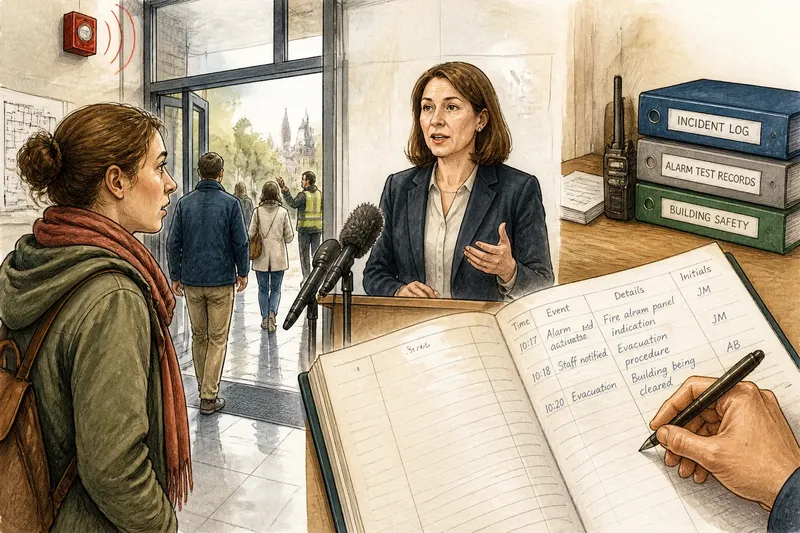
These roles are easiest to compare through a single invented situation: a town hall is evacuated after an alarm. A person in the foyer, a council spokesperson and the building’s incident log may all contribute useful information, but they answer different questions.
1. A witness can describe what they perceived
A witness account is strongest on direct experience: what someone saw, heard or did from a particular place. The person in the foyer might describe hearing an alarm and being directed towards an exit. That account can help establish how the evacuation felt and unfolded from that vantage point.
But a witness is not automatically in a position to explain why the alarm sounded, who activated it or whether every room was cleared. Sightlines, noise, stress and attention shape what a person notices. A confident account can still be incomplete without being dishonest.
Check the scope of the account before adopting its wording. Did the witness see the relevant event themselves, or hear about it afterwards? Where were they, what could they see, and which part of the timeline are they describing? “I heard the alarm” and “the alarm was triggered by smoke” are not equivalent claims.
News reports also compress speech. A witness quoted describing a loud bang may be offering a sensory detail, not identifying its cause. Keep the distinction visible when paraphrasing: attribute what the person perceived, and do not quietly turn it into an explanation.
2. A spokesperson can state an organisation’s position
An official spokesperson is generally speaking for an organisation, not merely recounting a personal experience. In the invented evacuation, a council representative might say the building was cleared while staff checked the alarm. That can tell readers what the council says it did, what position it is taking and which details it is prepared to put on the record.
The role does not make every statement false or true. It does make the speaker’s access and purpose relevant. A spokesperson may have information gathered from colleagues, but may not have witnessed the event. They may also be authorised to discuss only certain matters, or to avoid comment while an inquiry is under way.
Separate the wording carefully. “The council says the building was cleared” reports the organisation’s statement. “The building was cleared” states the event directly. Those sentences carry different levels of attribution; a short edit can erase the difference.
Look for what the statement does not address as well as what it does. Does it answer the question asked, identify the basis for its account, and distinguish confirmed details from points still under review? A prompt, polished response may clarify the organisation’s position without resolving what happened.
3. A document can preserve a record made for a purpose
A written record can show what was entered, sent, approved or recorded in a particular process. The town hall’s incident log might show that an alarm was recorded and that staff noted an evacuation. It could help establish the sequence documented by the person or system responsible for keeping that log.
Yet a record is not a transparent window onto the whole event. An incident log may omit details irrelevant to its purpose, contain an entry added later, or reflect what staff knew at the time rather than what became clear afterwards. A document can be authentic and still be limited.
Ask who created it, when, for whom and under what procedure. Then check whether the report quotes the document directly, paraphrases it, or describes a copy supplied by someone else. A form, an internal email and a signed public notice are all documents, but their creation and review processes differ.
Wording matters here, too. A log that says “alarm activated” does not necessarily identify the trigger. A record of a staff check does not by itself establish that every area was inspected. Read the entry for what it records, not what its format seems to imply.
4. Match the source to the question it can answer
Source roles become useful when the question is precise. “What did people in the foyer experience?” points towards witnesses. “What did the council say it had done?” points towards a spokesperson’s statement. “What was entered in the incident log?” points towards the document.
For a question about cause, none may be enough alone. The witness may have heard the alarm but not know its trigger; the spokesperson may provide the current explanation; the log may record a notification without explaining the underlying fault. The answer should reflect those limits rather than forcing the sources into a contest.
Imagine a reporter has the foyer witness’s account, the council statement and a log entry. A careful report could say the witness heard the alarm, the council said the building was evacuated during checks, and the log records an alarm activation. The expected reader-facing result is a clear account of what each source contributes, without claiming that any one item explains the cause.
A useful mental model is a set of different keys: each opens a different lock, but none opens every door. More sources do not automatically settle a question if they all address the wrong part of it.
5. Compare accounts without turning them into interchangeable proof
When accounts differ, first check whether they actually conflict. A witness may describe hearing the alarm before seeing staff; a log may record the alarm before an evacuation entry. Those descriptions could fit together because they cover different moments or perspectives.
Then inspect the chain behind each item. A witness may be quoted by a reporter; a spokesperson may be relaying information from a department; a document may be summarised by someone who has not published it. Each hand-off can affect how much of the original wording and context remains visible.
When the source basis is unclear, preserve that uncertainty in your own description. “The report attributes the account to a witness” is more precise than implying you know what the witness personally saw. If the document is only described rather than shown, say that the report says a record contains the detail.
Which source fits the question?
Can a witness explain why something happened?
A witness can report what they perceived and may offer an interpretation, but perception alone does not establish cause. Treat the explanation as a separate claim that may need other evidence.
Does an official statement prove an organisation’s account?
It establishes what the organisation has said, not automatically whether every underlying event occurred as described. Attribute the statement and examine what information the organisation gives for its position.
Is a written record more reliable than a person’s memory?
It depends on what the record was made to capture and how it was created. A record may preserve a timely entry, while a witness may provide detail absent from the form; neither role settles every question.
What if the three sources appear to disagree?
Compare their exact claims, vantage points, timelines and purposes before calling them contradictory. If a genuine gap remains, state it rather than choosing a source simply because it sounds more authoritative.
For news literacy, the practical question is not which source looks strongest in the abstract, but what the source is positioned to show in this particular story. Keep the witness’s perception, the spokesperson’s institutional account and the document’s recorded entry distinct. That small habit makes your own retelling more accurate—and leaves room for the next piece of evidence to answer what these sources cannot.