A Claim, a Fact and an Inference Are Not the Same Thing
Learn to distinguish a claim, a fact and an inference so you can see what each sentence establishes and avoid treating a plausible reading as proof.
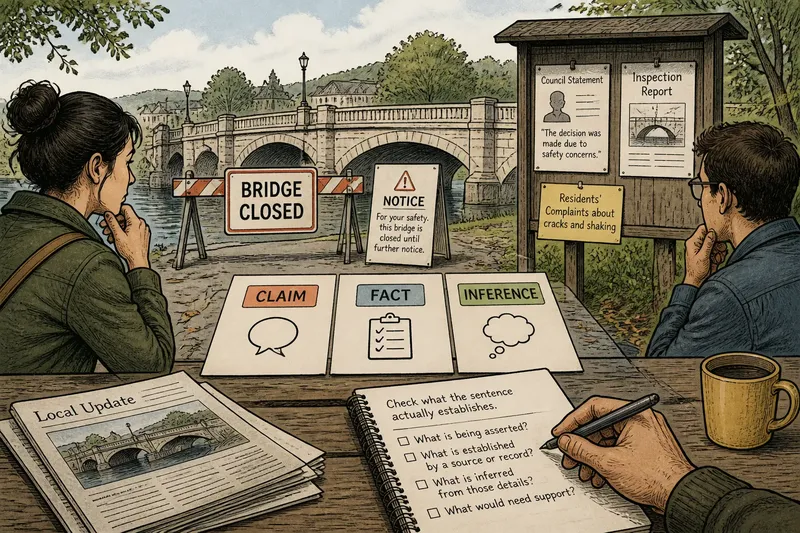
The common mistake when reading a disputed story is to treat every confident sentence as a fact. That can turn a claim into apparent proof, or make an inference sound like something a source directly established. Distinguishing a claim, a fact and an inference helps you see what the wording supports—and where your own reasoning begins.
These categories are not labels for sentences that are automatically true or false. A claim is something being asserted; a fact is information presented as established; an inference is a conclusion drawn from information. The practical question is narrower: what does this particular sentence actually establish, and what would still need support?
When a claim sounds like a settled fact
A claim can be reported in a flat, declarative sentence: “The council closed the bridge because it was unsafe.” The sentence asserts both that the bridge closed and why. Its grammatical confidence does not establish either part by itself.
Readers often miss this because claims can carry concrete details, official-sounding language or a named speaker. Those features may help identify where the assertion came from, but they do not change what it is: an assertion that needs to be assessed. Separate the claim into its pieces before accepting the whole sentence.
- What event is said to have happened?
- What cause, motive or consequence is attached to it?
- Who is making the assertion, and is the sentence reporting their view or stating it in the writer’s voice?
Each part may have a different basis. A notice might establish that the bridge was closed, while a council statement attributes the decision to safety concerns. That still does not, on its own, establish the precise physical condition of the bridge or rule out other reasons.
When a reported fact is mistaken for the whole explanation
News reports often present information as fact because a source or record supports it: a meeting took place, a written notice was issued, or a named person made a statement. Even when such details are sound, their scope matters. A record that documents a decision establishes that the decision was recorded; it may not establish every reason behind it.
The trap is letting a supported detail carry an unsupported neighbour. “The council issued a closure notice” and “the bridge was in immediate danger” are not interchangeable. The first describes a documented action. The second makes a claim about the bridge’s condition, which calls for evidence suited to that question.
Try asking what would count as direct support for the exact wording. A dated notice may support when a closure was announced. An inspection report may address a stated defect. A spokesperson’s explanation establishes what the spokesperson said, not automatically that the explanation is complete or independently confirmed.
Think of a fact like a label on a file folder: it tells you what has been put there, not everything inside the folder. A reliable sentence can still be a narrow one. Preserve that narrowness instead of stretching a solid detail into a sweeping account.
When an inference feels too obvious to question
An inference connects information to a conclusion. It may be sensible, even likely, but it is still a step beyond the details that prompted it. For example, a closed bridge and a warning sign might lead a reader to infer that an inspector found a hazard. Unless the inspection or its result is documented, the inference has not established that explanation.
This is where readers can confuse “fits the available details” with “shown by the available details”. Several explanations might fit the same facts. A closure could follow an inspection, planned maintenance or an administrative decision; the closure alone does not select among them.
To check an inference, write down its starting information and its added conclusion. Then ask what other explanation could connect those same details. If plausible alternatives remain, describe the conclusion as an inference or possibility rather than upgrading it to fact.
When one sentence contains all three layers
A sentence may combine a recorded event, someone’s claim and a reader’s inferred cause. Consider: “After residents complained about cracks, the council closed the bridge to protect the public.” The complaint and closure may be documented; “to protect the public” may report an official explanation, or it may be the writer’s interpretation. The sentence’s phrasing alone does not tell you which.
Say you read a local update that says a library cancelled an evening event after a safety complaint. The cancellation and complaint are stated as events, while the complaint’s role as the reason for cancellation may be an inference. You could check the library’s notice for its stated reason and keep the conclusion modest if it gives none: the event was cancelled after the complaint, not necessarily because of it.
Notice how small words can carry a large inference. “After” sets out sequence; “because” asserts cause. “Associated with” suggests a connection; “caused by” makes a stronger claim. Read those words slowly, especially when a headline compresses a longer account.
How can you tell what a sentence establishes?
Does a direct quote make a claim a fact?
A quote establishes that a person made the quoted statement if the quotation is accurately reported. It does not by itself establish that the statement is true. Keep the speaker’s assertion distinct from information that independently supports it.
Can a fact still be disputed?
Yes. Information presented as established can be challenged if its wording is unclear, its source is mistaken or relevant evidence conflicts with it. “Fact” describes how the information is being treated in a report, not a promise that no correction could ever be needed.
How do you spot an inference in a headline?
Look for wording that supplies a cause, motive, intention or consequence not plainly stated in the details beneath it. Ask whether the headline reports a source’s explanation or draws a conclusion from events. If that distinction is missing, read the body text before adopting the headline’s interpretation.
What should you write when the evidence is incomplete?
Use wording that preserves the boundary: “the notice says”, “the official stated”, or “the timing suggests”. These phrases identify whether you have a documented detail, a reported claim or your own inference, without pretending that uncertainty has disappeared.
When wording hides who is asserting what
Some sentences blur the boundary with passive phrasing: “It was decided that the site posed a risk.” Who decided? What information did they rely on? Passive voice is not automatically misleading, but it can hide the difference between a documented decision and a verified condition.
Other sentences use broad labels such as “confirmed” or “proved” without saying exactly what was confirmed. Check the object of the verb. A source may have confirmed that a meeting occurred, not that every account of the meeting is accurate. A document may prove that a warning was issued, not that the warned-about outcome happened.
When the sentence is vague, do not fill the gap with the most dramatic interpretation. Locate the precise assertion, identify who is responsible for it, and note what kind of support would bear on it. If the wording still leaves two readings, preserve that ambiguity rather than silently choosing one.
When a correction fixes only part of the sentence
A correction may settle a date, name or recorded action without resolving the explanation attached to it. Treat revisions with the same care as the original report: identify which specific statement changed and which remains a claim or inference. One corrected detail does not automatically validate the rest of the account.
For a claim, fact and inference, the useful habit is to give each sentence only the weight its support can carry. State the documented detail plainly, attribute a claim to its speaker, and mark an inference as an inference. That distinction makes room for a clearer next question: not merely whether a sentence sounds convincing, but what evidence could establish the part it asks you to believe.