The Missing Paragraph Problem: How Context Changes a Quotation
The missing paragraph problem can turn a careful qualification into a sweeping claim. Restore the surrounding passage before deciding what a quotation means.
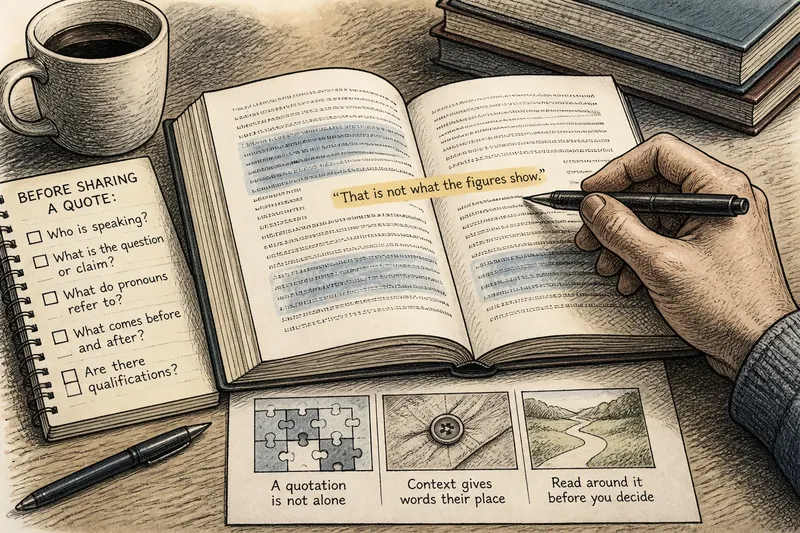
The most common mistake with a striking quotation is to treat the clipped sentence as if it arrived alone. The missing paragraph problem can turn a speaker’s narrow qualification into what looks like a sweeping claim, sending readers towards a conclusion the full passage does not support.
A sentence may be copied accurately and still mislead when the sentences around it are gone. A quick way to check is to pause before sharing or judging the excerpt, then read the paragraph immediately before it, the paragraph containing it, and the one after. That small habit helps restore what the speaker was answering, qualifying or referring to.
A quotation carries its neighbours with it
Paragraphs are not just containers for sentences. They help establish a topic, introduce a contrast, explain a pronoun such as “this”, and show whether a writer is reporting a position or endorsing it. Remove that scaffolding and the surviving words can appear to make a different point.
Consider a sentence that begins, “That is not what the figures show.” Without the earlier passage, a reader cannot tell what “that” refers to. It might reject a claim about a particular group, a proposed explanation, or an entire report. The words remain intact; their target has vanished.
A nearby paragraph can also set a boundary. A writer might describe an overall trend, then note that it does not apply to every location or every case. A cropped excerpt that keeps the broad statement and drops the qualification can make a careful account seem absolute.
Think of a quotation as a loose button: it may look complete on the table, but the surrounding fabric shows where it belongs. The analogy has limits, but the practical point holds: placement gives words part of their meaning.
Restore the immediate context before deciding
Start with the excerpt exactly as it appears. Note who is speaking, what point the words seem to make, and which terms depend on earlier information. Watch for “this”, “they”, “however”, “because”, “but” and phrases such as “in that case”. They often signal that the passage leans on something just outside the crop.
Then find the original item if it is available. Use the linked article, transcript, report or recording rather than relying only on a reposted image. Search for a distinctive phrase in quotation marks, or follow the source link and locate the sentence on the page. If the item is a transcript, check that the excerpt belongs to the relevant speaker and exchange.
Read a short stretch on both sides before forming a verdict. First ask what question the passage is answering; then ask what the speaker means by its central terms. Finally, check whether the next paragraph narrows, corrects or extends the point. This is a reading habit, not a hunt for one magic sentence that settles everything.
- Identify the speaker and the immediate subject of the passage.
- Look back for the question, claim or event the excerpt responds to.
- Look ahead for qualifications, corrections, contrasts or consequences.
- Check whether pronouns and phrases such as “this result” have clear referents.
- Compare the excerpt’s apparent certainty with the full passage’s wording.
Each item answers a different problem. A quotation can be attached to the wrong speaker, separated from its prompt, or stripped of a limitation. The surrounding paragraphs help reveal those differences, though they do not automatically establish whether the speaker’s underlying claim is true.
Separate a changed emphasis from a changed meaning
Not every short quotation is unfair. A concise excerpt can represent a passage faithfully if it preserves the point and does not conceal a nearby qualification that changes the reader’s likely interpretation. The question is not simply how much text is missing; it is whether the missing text matters to the claim being made about the excerpt.
Sometimes context changes emphasis rather than basic meaning. A speaker may state a view plainly, then spend several paragraphs explaining its implications. A short quote could accurately convey the view while leaving out that explanation. That may make the speaker sound less careful or less nuanced, even if the core position remains the same.
In other cases, the omitted material changes the scope. Imagine a council report says that a new timetable improved access at several busy stops, then explains that the trial did not cover quieter routes. A social post repeats the first sentence as though it applied to every stop. The immediate context restores the limit: the claim concerns the stops described, not the whole network.
That invented example illustrates a useful distinction. Context can show what a claim refers to, how broadly it applies and whether a qualification belongs with it. It cannot, by itself, tell you whether the report’s evidence is sound or whether another source disagrees.
Notice when the original passage is hard to recover
Sometimes a link is broken, a transcript is incomplete, or a screenshot gives no publication details. Treat that as a limit on what can be concluded, not proof that the excerpt is false or deceptive. You can describe what the quoted words say while leaving open what the missing passage might add.
Be especially cautious when a post presents a sentence as a complete verdict but does not identify the document, interview or speaker. Searchable wording may lead to the original, but copied text can also be edited or attributed loosely. If you cannot establish where it came from, avoid presenting an interpretation of its surrounding context as settled.
When the source is available but very long, focus first on the immediate exchange or section. A full report may contain useful background, yet the nearest paragraphs often resolve the first question: what is this sentence responding to? Broader context can follow if it changes the scope or adds a material qualification.
What should you check before sharing an excerpt?
How much surrounding text should I read?
Begin with the paragraph before and after the quoted passage, plus the paragraph containing it. Read further if a reference remains unclear or a later section explicitly revises the point; there is no need to treat every excerpt as a demand to read an entire document.
Can a quote be accurate but misleading?
Yes. Its wording may match the source while the crop omits a condition, a question or a distinction that changes the apparent scope. Accuracy of transcription and fairness of presentation are related, but they are not the same judgement.
What if the source provides no surrounding paragraphs?
Say what can be checked and what remains unknown. Without the original passage, you cannot responsibly claim that missing material confirms or overturns the excerpt’s apparent meaning.
Does restoring context prove the claim?
No. It clarifies what the speaker or writer appears to mean in that passage. Assessing whether the claim is supported calls for attention to its evidence and to any relevant information beyond the quotation.
The missing paragraph problem is easiest to catch at the moment a quote feels decisive. Before treating it as a verdict, restore its immediate context and ask what the neighbouring sentences change. That brief pause can prevent a clipped sentence from doing more work than its source allows.