When a Developing Story Has No Final Answer Yet
A calm routine for reading a developing story: separate confirmed details from open questions and spot what new information could change.
The most common mistake with a developing story is treating its latest update as the finished account. That can leave you repeating an early explanation as fact, or dismissing later corrections as contradictions when the picture was incomplete from the start.
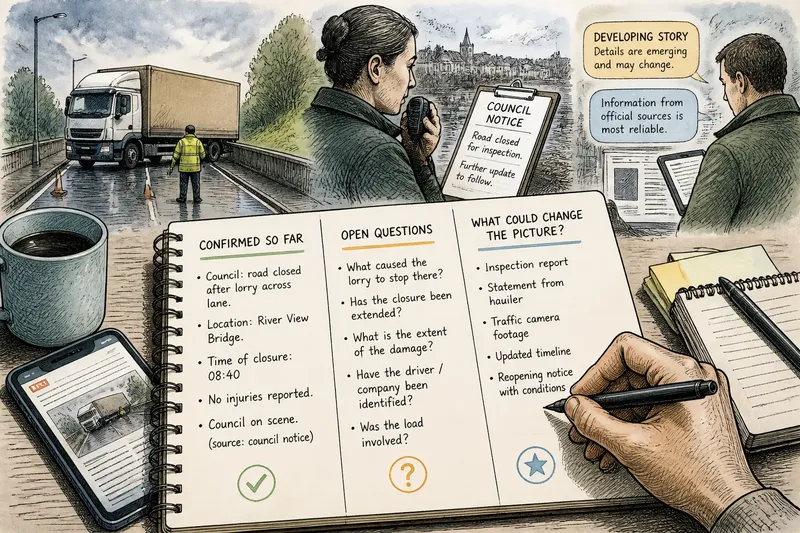
Reading a developing story well means keeping a small, flexible record: what is currently confirmed, what remains open and what new information could change your understanding. This is not a demand to distrust every report. It is a way to follow the news without asking an early dispatch to answer questions it cannot yet settle.
What counts as a developing story?
A developing story is one in which important details are still emerging, being checked or disputed. The basic event may be clear while its cause, scale, sequence or consequences remain uncertain. A report can be accurate about what is known at the time and still be incomplete.
News outlets often signal this with words such as “live”, “breaking” or “developing”. Those labels tell you something about the reporting process, not how reliable every sentence is. A live page may mix freshly confirmed information with earlier material, background and questions that reporters are still pursuing.
It helps to distinguish an update from a completed account. An update adds or revises information; it does not automatically close the story. Think of a developing report like a map with some roads marked and others still blank: the blank space is not evidence that nothing lies there, and the marked route may still need adjusting.
What is confirmed so far?
Start by writing down only the details the report presents as established, and keep each one specific. “Officials have announced an evacuation” is clearer than “the area is in danger”; the first describes an announcement, while the second may imply a broader conclusion.
Check who is making each claim and what their role allows them to know. A local authority may confirm its own decision, while a witness may describe what they saw from one location. Neither source, by that fact alone, can settle every question about cause or responsibility.
Useful confirmed details may include a time, place, action or formal decision. Keep the wording close to what the source actually says, and note if the report attributes the detail to a particular person, agency or document. This prevents an attributed claim from quietly becoming an unattributed fact in your retelling.
Imagine a report says a bridge has been closed after a vehicle struck a barrier. You could record “the transport authority says the bridge is closed” as confirmed, while leaving the vehicle’s speed and the reason for the collision open. That small distinction preserves what the announcement establishes without filling in the missing cause.
Which questions are still open?
Open questions are the material parts of the account that the available information has not settled. They might concern what happened immediately before an event, how many people were affected, whether a reported connection is causal, or whether different accounts can be reconciled.
Make the questions concrete rather than writing “we do not know enough”. For instance: “Has the closure been extended?”, “Is the reported damage confirmed by an inspection?” or “Have the people involved been identified by an authorised source?” A well-framed question makes it easier to notice when an update answers it—and when it merely adds adjacent detail.
Some questions may remain unanswered for a long time, or never be settled publicly. That is different from evidence that supports one answer over another. If a report offers a plausible explanation but says it has not been verified, keep the explanation in the open-question column rather than upgrading it through repetition.
There is no need to list every imaginable possibility. Focus on questions that could change the basic account or affect what readers should understand next. Speculation about motives, hidden actors or dramatic consequences can crowd out those more useful uncertainties.
What could change the picture?
Before checking for another update, decide what kind of information would materially alter your understanding. It might be a confirmed timeline, an inspection report, a statement from a directly involved organisation, or evidence that revises the reported location or sequence. The relevant information depends on the story; the point is to identify a meaningful change rather than chase every new post.
Keep an eye on whether a later report answers the question you had in mind, changes an earlier detail or simply repeats it with added commentary. A new headline can sound decisive while the underlying information remains the same. Read the actual wording, including qualifications such as “according to”, “appears” and “has not been independently confirmed”.
Say you are following a fictional report about a temporary road closure after a lorry is found across a lane. At the outset, the closure and the vehicle’s position are attributed to the council; the cause is unknown. If a later council notice says the road has reopened after an inspection, that changes the practical picture, but it does not by itself establish why the lorry stopped there.
A useful update should be judged by what it adds, not by how emphatically it is written. Keep earlier notes rather than silently replacing them: a short record of “then” and “now” helps reveal whether the account has genuinely changed or merely grown more detailed.
How can you follow updates without overreacting?
Choose a small number of sources that can contribute distinct information, such as a responsible local authority and a reputable newsroom reporting the event. Rechecking the same unverified claim across multiple accounts can create the impression of confirmation when they may all be relying on one original statement.
When an update appears, ask three quick questions: What is new? Who is the source? Does it answer an open question or introduce another one? If the report corrects a detail, note the correction plainly. A correction is a useful part of the reporting record, not a reason to preserve the original wording as though both versions were equally current.
For a live page, check timestamps and distinguish newly added material from older paragraphs that remain visible. A page may be edited without every previous detail being removed. If an item has a clear correction notice or updated headline, read it before sharing a clipped sentence or screenshot.
It can also help to set a reason for checking again: a scheduled announcement, a relevant official notice or a report expected to clarify a specific point. This keeps attention on meaningful developments. Refreshing constantly may deliver more fragments without making the account clearer.
When does an update become a final account?
There may be no single moment when a developing story becomes final. Some parts can be settled while others remain contested, under investigation or unavailable. Treat “final” as a claim about the completeness of a particular account, not as a label that follows automatically from elapsed time or a confident headline.
Look for whether the reporting explains what remains unresolved and whether later details have been checked against relevant sources. A comprehensive account should distinguish established facts from explanations and acknowledge material gaps. Even then, new records or testimony may alter parts of the story.
For your own use, it is often enough to say “the latest confirmed account is…” and state its limits. That phrasing is more informative than either declaring the matter settled or treating every possibility as equally likely. It tells another reader where the account stands without pretending to know what has not been established.
What should you do when reports disagree?
First check whether the reports are actually describing the same detail, time or source. One may report what an official said, while another describes what a witness observed; those statements can differ without directly contradicting each other. A change in an estimate or a corrected location may also reflect new information rather than bad faith.
Compare the exact claims and their attribution. If one report says a cause is confirmed and another says it remains under review, ask whether they rely on different evidence or were published at different stages. Dates and update times can make an apparent dispute easier to understand.
If the disagreement is real and unresolved, keep it visible. You can report that accounts differ, identify who says what, and avoid choosing the version that feels most satisfying. Do not merge incompatible details into a tidy story just to remove the discomfort of uncertainty.
How should you share an unfinished story?
Share the narrowest accurate claim that serves your purpose, and include its source and status. Instead of forwarding a dramatic headline alone, say that a particular agency has confirmed a closure, while the cause is still under investigation. This gives the next reader useful context without smuggling an inference into the claim.
Before reposting a screenshot, check whether it shows the current version and whether the surrounding text qualifies the statement. A sentence lifted from an earlier update can become misleading after the report changes. If you cannot check the current account, it is reasonable to wait rather than pass along a fragment as settled news.
When a correction arrives, update your own post if you can. If you have shared a claim that is now revised, a brief note identifying the correction helps prevent the old version from travelling on its own. Accuracy is not a performance of certainty; it is a willingness to keep the account aligned with what is currently supported.
The simplest routine for a developing story is to preserve three distinctions: what has been confirmed, what remains unanswered and what would genuinely change the picture. Use that routine when reading a developing story, and you can stay informed without mistaking the newest fragment for the last word.